
Dependence Before Independence
America250 and the Prayer That Preceded the Revolution

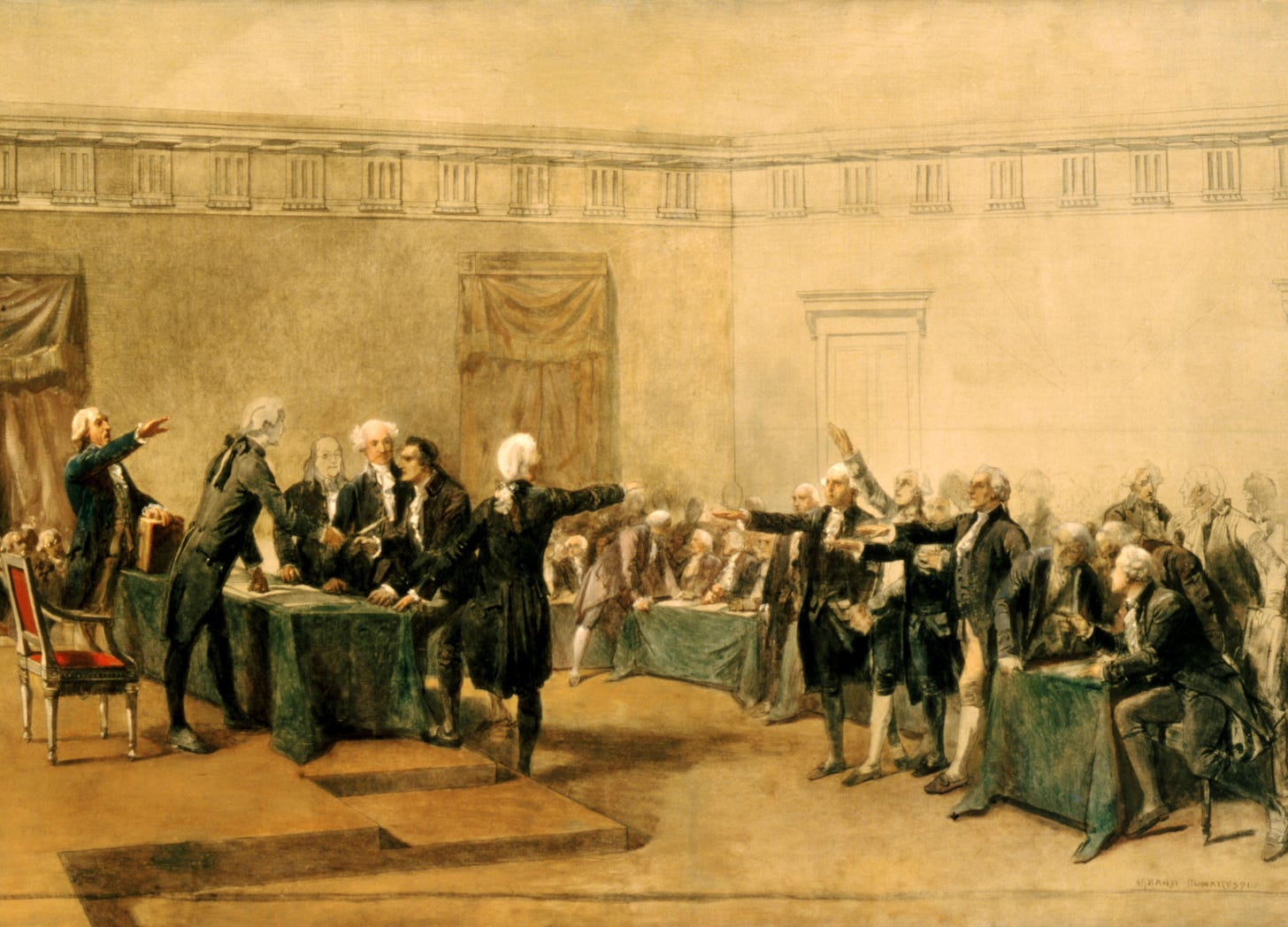
In early September 1774, dozens of delegates traveled from twelve colonies to Carpenter’s Hall, most of them strangers to one another. New England radicals sat near Pennsylvania Quakers who thought the whole enterprise reckless. Virginians who still hope for reconciliation with the Crown sat near delegates who had already concluded that reconciliation is a fantasy. Nobody in that room had agreed yet on what they were even there to do, let alone what might happen next.
It was suggested that the session begin with prayer. Even this idea was fraught with controversy. The room was a genuine mix of denominational backgrounds, and more than one delegate worried that a prayer suited to one tradition would alienate the rest. Then word reached the hall (a rumor as it turned out, but believed at the time) that British ships had opened fire on Boston. Whatever reluctance remained about prayer evaporated. Thomas Cushing moved that Jacob Duché, rector of a local church, be asked to open the morning’s session.
Duché had not prepared a sermon or homily for the occasion. He simply read the appointed lection for the day, which happened to be Psalm 35, and let it stand as the address to the room. It is a psalm of plea: an appeal to God to take up shield and buckler on behalf of the defenseless and to bring to nothing the counsel of those who plot in secret against the innocent. This psalm, with the rumor of cannon fire still hanging in the air, landed like it had been written specifically for the occasion.
Duché followed the psalm with an extemporaneous prayer, asking God for wisdom to guide the delegates, for unity among men who did not yet agree, and for protection over the colonies in the crisis ahead. John Adams, writing to Abigail nine days later, wrote that Duché’s prayer “filled the bosom of every man present.” Adams continued, “I must confess I never heard a better prayer or one so well pronounced … with such fervor, such ardor, such earnestness and pathos, and in language so elegant and sublime for America.”
After Duché finished, grown men who had walked in as strangers, some of them theologically and politically at odds with one another, sat together in tears. The Quakers wept alongside the Puritans. Whatever else divided that room, that morning did not.
Notice what had not yet happened by September 7, 1774. No Declaration had been drafted. No grievance had been formally lodged. Independence itself was not yet the settled aim of most delegates in that hall; many still hoped the crisis could be resolved within the empire rather than outside it. The men in that room had convened to figure out what to do, and they had not yet figured it out.
Yet before the Congress took up the great work of forming a common colonial response, they bowed before God.
What a thing to consider! The founding generation, facing the largest political crisis most of them would ever face, did not open with a strategy session. The Continental Congress appealed to the King of heaven and earth before they had agreed to defy the one on Britain’s throne.
The Continental Congress appealed to the King of heaven and earth before they had agreed to defy the one on Britain’s throne.
This year, the nation whose founding took shape in that room turns two hundred and fifty. Such a milestone is worth throwing a party over, and I mean that literally. Light the sparklers. Grill the hot dogs. Let the fireworks go long past when the kids should be in bed.
But before any of that, let's take a page from the delegates in Carpenter's Hall. Give thanks for two hundred fifty years of God’s blessings. Say a plain word of repentance for the ways this country has sinned against God. And pray, the way Duché asked, that truth, justice, religion, and piety may prevail and flourish amongst the people of this nation.
Such prayers were the foundation of this nation. Let us pray them again.
The First Prayer of the Continental Congress
O Lord our Heavenly Father, high and mighty King of kings, and Lord of lords, who dost from thy throne behold all the dwellers on earth and reignest with power supreme and uncontrolled over all the Kingdoms, Empires and Governments; look down in mercy, we beseech Thee, on these our American States, who have fled to Thee from the rod of the oppressor and thrown themselves on Thy gracious protection, desiring to be henceforth dependent only on Thee. To Thee have they appealed for the righteousness of their cause; to Thee do they now look up for that countenance and support, which Thou alone canst give. Take them, therefore, Heavenly Father, under Thy nurturing care; give them wisdom in Council and valor in the field; defeat the malicious designs of our cruel adversaries; convince them of the unrighteousness of their Cause and if they persist in their sanguinary purposes, of own unerring justice, sounding in their hearts, constrain them to drop the weapons of war from their unnerved hands in the day of battle!
Be Thou present, O God of wisdom, and direct the councils of this honorable assembly; enable them to settle things on the best and surest foundation. That the scene of blood may be speedily closed; that order, harmony and peace may be effectually restored, and truth and justice, religion and piety, prevail and flourish amongst the people. Preserve the health of their bodies and vigor of their minds; shower down on them and the millions they here represent, such temporal blessings as Thou seest expedient for them in this world and crown them with everlasting glory in the world to come. All this we ask in the name and through the merits of Jesus Christ, Thy Son and our Savior.
Amen.
Reverend Jacob Duché
Rector of Christ Church of Philadelphia, Pennsylvania
September 7, 1774, 9 o’clock a.m.